


Beyond the Festivities: The Significance of Lunar New Year for Migrant Workers
Rudy Chau '28
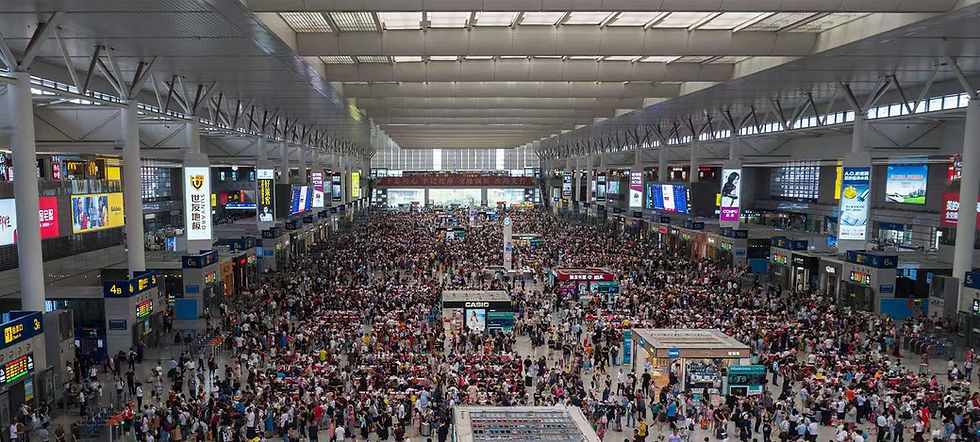
For most of the year, Shanghai is one of the loudest cities on Earth. However, for around a week, the noise slowly diminishes, with serenity taking the place of the cacophonous ensemble of car horns, shop advertisements, and voices on the roads. During the Lunar New Year, the Paris of the East witnesses a temporary exodus, as millions of migrant workers return to their hometowns to celebrate with their families. While many recognize the Lunar New Year as a festival full of mythological fables that form an iconic cultural tradition, for migrant domestic workers, it is a time for reunion, rest, and reflection on the sacrifices undertaken throughout the year. Now, two months removed from the festivities, the quiet return of city life offers a fitting moment to reflect on what the holiday truly meant for those who make Shanghai’s prosperity possible.
In China, the Lunar New Year marks the beginning of a new year, filled with rituals that honor ancestors, bring families together, and set a hopeful tone rooted in togetherness for the year ahead. According to the legend of Nian, a terrible beast would appear every New Year’s Eve to terrorize villages. Eventually, the people learned that it was afraid of loud noises, bright lights, and the color red. To protect themselves, families would decorate their homes with red lanterns, paper, and other decorations, light fireworks to sparkle brightly in the sky, and make as much noise as possible to deter the beast from returning.
This legend, regardless of its mythology, reflects a timeless theme regarding the necessity of community and unity. As individuals and families came together to dispel Nian, they not only protected themselves but also strengthened their bonds with one another. These customs reflect that no matter how difficult the previous year may have been, there is always strength to be found in togetherness.
In the context of migrant domestic workers, togetherness connects with them on a personal level. For the majority of some 300 million Chinese, who constitute the world's largest domestic migrant worker force, this is the only time they can return to their rural hometowns. These workers, many of whom leave their families to find work in ‘Tier 1’ cities such as Shanghai, Guangzhou, and Beijing, commonly experience long periods of separation.
Following increased economic prosperity and development in these areas, rural areas have become increasingly left behind, with sparse opportunities for work and income. Even as over 70% of migrant workers in China are employed in prolonged hours and low-wage jobs, the minimum wage in cities such as Shanghai provides them with over 2,740 RMB per month. In comparison, Wu and Zhang find that minimum wages in rural areas are as low as 550 RMB per month.
However, this long-term separation between migrant workers and their families often leads to considerable social and emotional consequences. To illustrate this, migrant domestic workers commonly face isolation due to the different cultures and dialects spoken in major cities. Additionally, Hou et al. reveal that up to 34.2% of domestic migrants face mental health issues such as depression. Meanwhile, the absence of primary caregivers has led to an increasing number of left-behind children who grow up without their parents and are often raised by grandparents or relatives.
Lu et al. report that 46% of these left-behind children are separated from their parents for more than two years. Specifically, 32% have been separated for more than 5 years. For over 60 million children, abandonment and loneliness are unfortunately common side effects.
In conclusion, the Lunar New Year offers migrant workers a key window of opportunity to connect with their families. While the holiday is built on community, it also reveals a difficult reality faced by millions who leave their rural homes in search of better financial opportunities, underscoring a deeper systemic divide. As communities gather to celebrate, the story of Nian reminds us that genuine strength is found in togetherness. However, to truly actualize this ideal, society must pay greater attention to the lives of migrant workers, ensuring they are not celebrated only during festivals but are supported year-round in meaningful ways.


Comments