


Reviewing Policy Changes

Jasmine Wu '26
Intro
As students may recall, last school year saw a series of schedule changes proposed by the school administration, as well as a wave of student opposition and community backlash. These changes were mainly centered around revising the current schedule, including adding double-blocks, Mega Week, and collaboration days. Members of the faculty also voiced concerns about drastic curriculum revisions to cater to the new schedule. Apart from revising the daily blocks of time, administration also gauged community perspectives on starting school later (by 30 minutes) and their interest in cross-campus learning at Pudong. This generated opposition from the parent community, who were concerned about traffic in the morning and disruption of the daily routine.
This article attempts to examine the series of policy changes and their points of contention through a neutral lens, clarifying the intentions behind them and offering constructive suggestions for improving collaboration between students and the administration.
DISCLAIMER: Despite rigorous research and interview work conducted in collaboration with the school administration, some elements of this article may misinterpret the school administration’s intentions, and certain facts may have been described incorrectly. The administration is not affiliated with this article or any of the opinions the author expressed in it.
A Review
The series of policy proposals began early in the school year, with the first wave of student consultation being a survey about interests in cross-campus courses, starting school later, and other ideas that would overhaul the current schedule. The form was quite lengthy, but the questions were often presented without explanation, and for many students, certain ideas seemed a bit out of the blue and impossible to implement. One particular question was phrased as, “Would you be interested in taking classes at SAS Pudong Campus?” Students felt confused as to the intentions behind this question and deemed this proposal very unrealistic. Soon, parents became extremely anxious over this question. Allegedly, some parents even speculated that Pudong was lacking students, so the administration wanted to “ship” Puxi students to Pudong. Anxiety escalated rapidly in unregulated parent group chats.
For the schedule change proposal, multiple student surveys were sent out to students about the components of the new schedule. Observing the general atmosphere among the student body and later gauging opinion through another survey, students were against the new schedule in an overwhelming majority.
Multiple student assemblies were also hosted to provide further information, where members of the administration, such as Ms. Kaste, went over the details surrounding ABCD days, double blocks, collaboration days, and Mega Week. However, assemblies proved to be an imperfect method of communication, and a lot of students were not paying attention. Students murmured in opposition, but most of the opposition stemmed from confusion.
The greatest resistance to the administration emerged when the administration introduced a delay of the start of the school day by thirty minutes. In parent group chats, debates clashed over this piece of policy in particular. A lot of parents cited inconvenience with sending kids to school during work, as well as increased traffic jams at that time, as the greatest barriers to agreeing to the policy. Eventually, when parents, being the most powerful group of stakeholders to the administration, began sending emails to the school board, the administrators slowed further plans in implementing the delayed school start.
Although it is worth mentioning that these initiatives do not fall under the same administrative plan, I have still compiled these changes to discuss them as a whole for two reasons. First, these policy proposals occurred in proximity. Second, even though the policies are distinct and affect different stakeholder groups in different ways, their overlapping implementation and the dissatisfaction they provoked fostered a collective sense of frustration and distrust toward the administration; therefore, reviewing these pieces of policy in a combined manner is helpful in understanding the backlash.
Confusion and Resistance - Policies and Their Intentions
Stakeholder confusion and resistance to new policies are closely connected. If those affected by a policy are confused, they are likely to resist it immediately, even if it may ultimately serve their interests.
In this case, the community’s confusion stemmed from inadequate and ineffective communication.
In the form sent out early in the school year to stakeholders, it was unclear to the parents and students the intent behind “Would you be interested in taking classes at SAS Pudong Campus?”, especially without further explanation given by the form. It was only after in-depth conversations and interviews with Ms. Kaste that I learned that the question was intended to gauge interest about potential specialized course openings at Pudong—an example being marine biology, where the Pudong campus can utilize its coastal resources that Puxi doesn’t have. Still, for most stakeholders, the intentions of the policies were not received and understood, leading to frustration, resistance, and misunderstandings surrounding the administration as a whole.
The same issue is seen in the process of consulting students about the new schedule. Despite communicating details about the new schedule through multiple student assemblies, as discussed earlier, this method of information delivery was not the most effective. In the assembly setting, with a large amount of information presented in a short period of time, students may struggle to process all proposed policy changes. With limited opportunities for follow-up questions and many students distracted or disengaged, important details were not always fully absorbed or clearly understood.
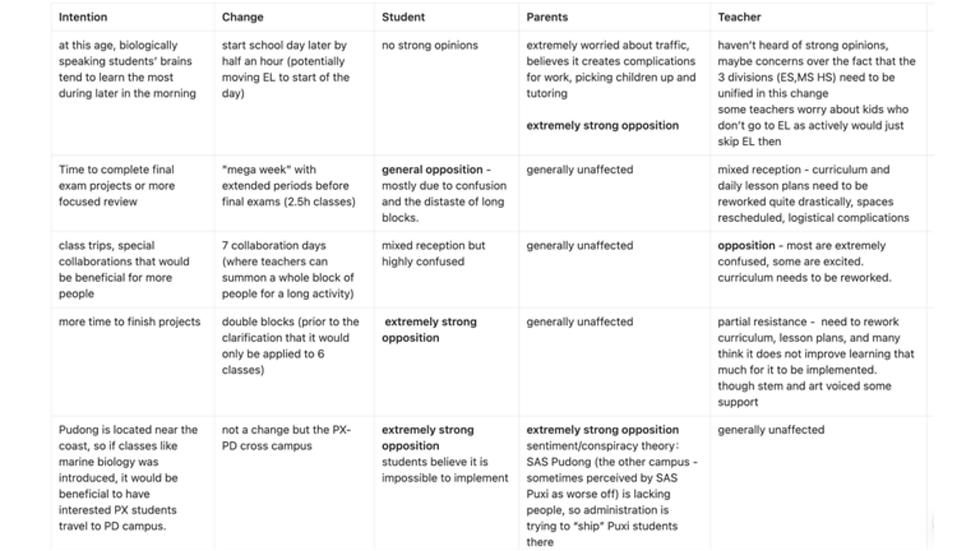
Note: Information sourced from interviews and conversations with faculty, students, parents, and the administration; a survey form about opinions on the new schedule; and general observations of student opinion and reactions.
As we can see from Table 1, when a piece of policy is negotiated and implemented, the perception of stakeholders is largely different from and often not the reality. Each of the stakeholders has their own interests and biases that hinder neutral judgment. During times of confusion, it is easy for students and other stakeholders to jump to quick, incorrect conclusions regarding the administration’s intentions. More skeptical students resorted to unfounded assumptions, often targeting institutions and authority in a generic sense. This included sentiments targeting the admin (“they don’t care about us”) and sometimes the student government (“they are a popularity contest,” “stuco doesn’t do anything”), resulting in an oversimplified understanding of a phenomenon (schedule change and policy change proposals) that is in reality a result of the interactions of a diverse web of stakeholders.
Complexity
While general cynicism among the student body targeting the school administration, as well as the role of student governments, is understandable if students feel their input is not heard, it is helpful to acknowledge the complexity in policy processes.
Talking to a former executive council president (Bo Xin Zhao ‘25), I learned that the student body has frequently oversimplified the duties and power of the student government. Many students either expect the student government to fulfill every demand of the student body or that the student government is just a popularity contest. These two highly polarized perceptions of the student government are extremely harmful to the operations of the student government and student representatives. Furthermore, Bo conveyed that student governments are only a part of the complex range of stakeholders involved in every policy change. Despite every candidate in every election vowing they would increase student government transparency, this is difficult to achieve in real life, as student governments cannot easily take full credit for all their work, as a lot of them were done in conjunction with the administration, so often times stuco or exec does not seem to be transparent enough.
In cases of strong community backlash to policies, it is important for stakeholders to recognize the complexity of the policymaking process and the complex web of stakeholders in which individual stakeholders are situated. The perceptions of stakeholders may not always reflect reality, and this article encourages students to approach the administration when anxiety arises and gain a fuller picture.
Suggestions to the Administration
Clearer Communication
The first suggestion I would like to give to the school administration is to improve communication with stakeholders to avoid confusion. This could be addressed by utilizing multiple communication channels to communicate intention, such as Schoology posts and grade group chats, rather than only relying on assemblies, which could prove ineffective considering the attention spans of students.
Something that further exacerbated stakeholder dissatisfaction is the perception that “the administration does not listen to students at all.” Here, the student government could act to bridge that gap. Although it is difficult for students to be fully transparent about policies in process, there are still steps that stuco can take, for example, collect a few questions from the grade before each meeting with the admin, release disclosable meeting notes of policy details, and create short videos where the students interview the administration about policy details as a means of Q&A, etc.
Fewer Changes At Once
The second suggestion is to implement fewer policies at once or implement gradual changes. Upon reviewing the proposed revisions in the schedule that the administration wished to implement, there were at least five changes that the administration attempted to implement simultaneously. According to Table 1, we can see that for every change, there is at least one stakeholder category holding some degree of substantial opposition towards that change, even if for other stakeholders, there are no strong opinions. This created a cumulative opposition towards the administration, and more to manage for the administration. A recommendation to reduce the resistance of the stakeholders is to implement fewer changes at a time. It is easier for the school administration to manage the sentiments of one group of stakeholders one by one than to manage all three stakeholder groups simultaneously. Also, as a general human instinct, many people are resistant to change, especially sudden, drastic, or multiple changes. Thus, small doses of change should be implemented instead of a large bunch all together at once.
Clearer Policy Names
The last suggestion I would give to the school administration is relatively trivial—which is to shift the naming of policies. “Collaboration Days,” “Mega Week,” “Personalized Learning,” and “Socio-emotional Learning” are suitable for marketing, but they make it difficult to visualize what the schedule will actually look like, especially to a group of confused stakeholders.
Reflection and Acknowledgement
Originally, before I conducted my investigation, like many students, I had several misconceptions about the school administration, but they were quickly clarified as I continued to collaborate with the administration and reached out for help.
In Mega Week, a group of friends and I visited Ms. Kaste’s office and discussed the stress and anxiety of having basically a final exam every single day in Mega Week, as well as both a cumulative project and a final exam for some classes. Ms. Kaste immediately contacted teachers who had both a project and a test during Mega Week and finals week, as it was not allowed in the Mega Week policies for teachers. Within thirty minutes, students received notifications of the cumulative project being moved to after winter break.
Members of the administration are approachable and genuinely committed to supporting students, leveraging tools (like policymaking, consultation, open-door policy) and responding and acting swiftly within their power.
Reflecting on my project, the administration proved to be supportive of students’ projects, even opposing or speculative in nature, and I highly encourage the students to approach the administration directly if they feel unconsulted or confused about policies that affect them.
I am very grateful for the administration allowing me to conduct my investigation and providing me with opportunities to observe meetings and offering in-depth insight into policies and operations.
I would also like to thank Mr. Martinez, my IB Global Politics teacher, for his continued guidance, support, and patience throughout my investigation. This project would not have happened without his encouragement and mentorship.



Comments